
What Is a Shaker Kitchen?
A Shaker kitchen is defined by its door. Five pieces of timber, four framing members around one flat recessed panel, with no carving, moulding or ornament of any kind.
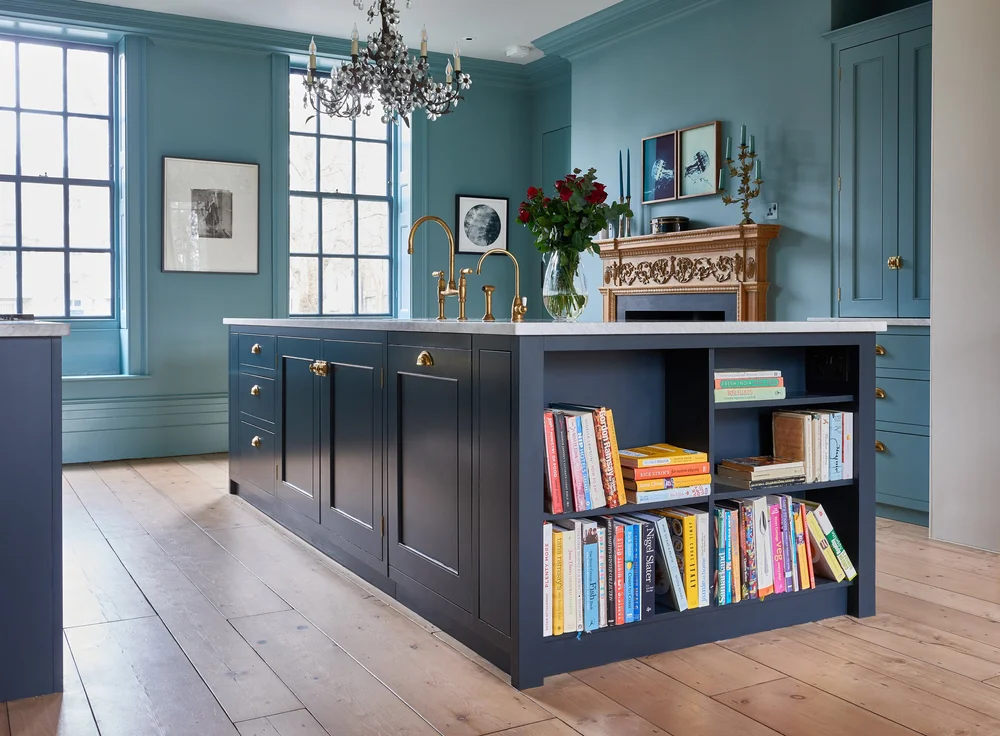
A Shaker kitchen is one fitted with Shaker doors: a five piece construction made from two vertical stiles, two horizontal rails and a flat central panel that sits recessed inside the frame. There is no moulding, bevel or decoration. The style takes its name from the Shaker religious communities of eighteenth century America, whose furniture stripped out ornament on principle. It remains the most popular door style in British kitchens because the plain frame suits period and modern rooms equally well.
How a Shaker door is built
The construction is what makes a door Shaker, not the colour or the handle. Five separate pieces of timber or engineered board are jointed together.
| Component | How many | What it does |
|---|---|---|
| Stiles | Two | The vertical outer members running the full height of the door |
| Rails | Two | The horizontal members spanning between the stiles at top and bottom |
| Centre panel | One | A flat panel sitting recessed inside a groove in the frame |
| Joints | Four | Mortice and tenon or dowelled, holding the frame square |
| Groove | Continuous | Cut into the inner edge so the panel floats rather than glues in |
The detail that separates a good Shaker door from a cheap one is the panel. In proper joinery the panel floats in the groove so it can move with humidity without splitting the frame or cracking the paint at the joint line. In cheaper construction the panel is glued or pinned, which looks identical on day one and shows a hairline crack along the frame within a few winters.
Frame widths are the other tell. A traditional Shaker stile is typically between 57mm and 76mm wide. Narrower frames read as contemporary, wider frames as farmhouse. Getting that proportion right for the room is one of the quiet decisions a designer earns their fee on.
Real Shaker against Shaker effect
A large share of kitchens sold as Shaker are not five piece doors at all. This is the most common misunderstanding in the category, so it is worth being blunt about it.
| Construction | How it is made | How to spot it | Typical use |
|---|---|---|---|
| True five piece Shaker | Five separate pieces jointed together | Visible joint lines at the four corners | Bespoke and premium fitted kitchens |
| Routed Shaker effect | One sheet of MDF with a rectangle machined out | No joint lines anywhere on the door | Mid range and retail kitchens |
| Applied moulding | A flat door with a frame stuck to the face | A raised lip standing proud of the door surface | Budget and refacing products |
None of the three is wrong in itself. A routed MDF door takes paint beautifully and will never split at a joint, because there are no joints. What it will not do is show the grain and shadow line of real jointed timber. It also cannot be repaired if the face is damaged.
Look at the four inside corners of the frame. A true five piece door shows a faint line where the rail meets the stile, even under paint. A routed door has a continuous unbroken surface. Neither is a fault. It is simply a different product at a different price.
Shaker against in-frame Shaker
The second common confusion is between a Shaker door and an in-frame kitchen. They describe different things and can be combined.
Shaker describes the door. In-frame describes where the door sits. A standard Shaker door is hung on the front of the carcass, covering its edges. An in-frame Shaker door sits inside a face frame fixed to the carcass, so the frame is visible around every door and drawer. The look is deeper and more like freestanding furniture. It costs considerably more because the tolerances are far tighter.
The full construction detail of the in-frame method is covered in What Is an In-Frame Kitchen. The itemised cost effect across a whole kitchen is in How Much Does a Bespoke Kitchen Cost.
Why Shaker kitchens are so popular
Shaker has been the best selling door style in Britain for well over two decades. The reasons are practical rather than fashionable.
- It sits in both worlds. The plain frame reads as traditional in a Victorian terrace and as restrained in a modern extension. Few styles cross that line.
- It takes colour well. The recessed panel creates a shadow line that gives depth to flat paint, so a single colour never looks flat.
- It photographs honestly. There is nothing to date it in a listing photograph in ten years time.
- It is easy to clean. Flat surfaces and a single internal corner, against the multiple mouldings of a raised panel door.
- It is repairable. A painted timber or MDF frame can be rubbed down and recoated repeatedly.
- It suits any handle. Knobs, cup pulls, bar handles and edge pulls all sit correctly on a flat frame.
Hand painted Shaker kitchens for North London homes
We build five piece Shaker doors in our own workshop, sized to your room and hand painted in any colour you choose. Victorian terraces, Edwardian villas and side return extensions across Islington, Hackney, Barnet, Haringey, Enfield and Walthamstow.
Are Shaker kitchens dated?
This question comes up constantly, so here is a straight answer. Shaker is not dated. What dates is the way people specify it.
The style itself is nearly two hundred and fifty years old and has outlived every fashion cycle since. A plain frame around a flat panel carries no period markers at all. What ages badly is everything bolted onto it: heavy ornate handles, dark red mahogany stains, glazed wall units with leaded panes, decorative plate racks, pelmets and corbels, plus the specific greys that dominated the 2015 to 2020 period.
Strip those away and a Shaker kitchen from 2005 and one from today are close to indistinguishable. That is precisely why it keeps selling.
| Element | Ages badly | Stays current |
|---|---|---|
| Frame width | Very wide farmhouse frames | 57mm to 76mm, proportioned to the room |
| Colour | Trend greys and strong accent colours | Off whites, soft neutrals, deep muted tones |
| Handles | Ornate cast ironmongery | Simple knobs, cup pulls, plain bar handles |
| Wall units | Glazed with leaded panes and pelmets | Plain runs, open shelving or none at all |
| Worktop | Mottled speckled granite | Quiet stone, composite or timber |
| Extras | Plate racks, corbels, spice drawers on show | Clean runs with the storage inside |
Colour is the single largest factor. It is also the cheapest to change on a hand painted kitchen. Hand Painted Kitchen Colours covers which colours hold up and which ones do not.
What Shaker doors are made from
Three material specifications dominate. The choice affects both the finish and how the door behaves over twenty years.
| Material | Frame | Panel | Best for |
|---|---|---|---|
| Full solid timber | Solid oak, ash or tulipwood | Solid timber, floating | Stained or oiled finishes where the grain is wanted |
| Timber frame, MDF panel | Solid tulipwood or ash | Moisture resistant MDF | Hand painted kitchens, the usual bespoke choice |
| Full MDF | Moisture resistant MDF | Moisture resistant MDF | Painted kitchens on tighter budgets |
| Veneered | Veneered engineered board | Veneered engineered board | A wood look without solid timber movement |
For a painted kitchen the second row is usually the right answer. A solid timber frame holds the joints and takes the knocks, while an MDF panel stays perfectly flat and will never show a grain line through the paint or open a gap in a dry winter. Full solid timber is the better choice only when the grain is meant to be seen.
Carcass material matters just as much as the door and gets much less attention. What Kitchen Cabinets Are Made From sets out plywood against MDF against chipboard.
Getting a Shaker kitchen right
- Set the frame width to the room. Narrower frames in a small flat, wider frames in a large period kitchen. Same door, very different result.
- Keep the ornament out. The style depends on restraint. Every added moulding works against it.
- Use drawers rather than cupboards. A bank of three Shaker drawer fronts reads better than one large door and works far better.
- Choose the handle late. Live with the colour first. Ironmongery is the one element you can change cheaply later.
- Mind the shadow line. Lighting across the frames is what gives a Shaker kitchen its depth. Flat overhead light kills it.
The last point matters more than most people expect. Kitchen Lighting Guide covers how to light a kitchen so the cabinetry reads properly. How to Plan a Bespoke Kitchen takes the layout decisions in the right order.
More on door styles and kitchen detail
Shaker, in-frame, handleless, worktops, colours, lighting and layout, written for people commissioning a kitchen rather than buying one. Everything sits in our Bespoke Kitchen Guides library.
Frequently asked questions
What is a Shaker style kitchen?
A Shaker style kitchen is one fitted with five piece doors made from two vertical stiles, two horizontal rails and a flat panel recessed inside the frame. There is no moulding, bevel or ornament. The style is named after the eighteenth century American Shaker communities, whose furniture removed decoration as a matter of principle.
What are Shaker kitchen cabinets made of?
Most painted Shaker doors use a solid timber frame with a moisture resistant MDF panel, which gives strong joints and a panel that stays flat under paint. Full solid timber is used where the grain is meant to be seen. Full MDF is common on tighter budgets. Carcasses are separate and usually plywood or moisture resistant board on bespoke work.
Are Shaker kitchens dated?
The style is not dated. It carries no period markers and has outlasted every fashion cycle for two centuries. What dates is the specification around it: ornate handles, dark stains, leaded glazed wall units, plate racks, pelmets and the trend greys of the late 2010s. Kept plain, a Shaker kitchen looks much the same twenty years later.
Why are Shaker kitchens so popular?
Because the plain frame works in both period and modern rooms, the recessed panel gives paint depth and shadow, the flat surfaces are easy to clean, any handle style sits correctly on it and a painted frame can be rubbed down and recoated rather than replaced. It is a practical choice more than a fashionable one.
What is the difference between Shaker and in-frame?
Shaker describes the door construction. In-frame describes where the door sits. A standard Shaker door hangs on the front of the carcass, covering its edges. An in-frame Shaker door sits inside a visible face frame fixed to the carcass. In-frame costs thirty to forty five per cent more because the tolerances are much tighter.
Are Shaker kitchens more expensive?
A five piece Shaker door typically adds fifteen to twenty five per cent over a plain slab on the same carcass, because five jointed pieces take more material and more workshop time than one flat panel. A routed Shaker effect door in MDF costs far less, usually five to twelve per cent above a slab.
Where to go next
Shaker earns its popularity honestly. It is a plain, repairable, adaptable door that suits almost any London room. The decisions that matter are frame width, colour and restraint rather than the style itself. Our Bespoke Kitchens North London page shows recent hand painted Shaker work across North London.
More from this guide series
- What Is an In-Frame Kitchen for the deeper furniture look
- Are Handleless Kitchens a Good Idea for the contemporary alternative
- Hand Painted Kitchen Colours for colours that hold up
- How Much Does a Bespoke Kitchen Cost for what each door style adds
- What Is a Bespoke Kitchen for the process behind the furniture
- Bespoke Kitchen Guides for every guide in the series
Send us a photograph of the room and the colours you are drawn to. We will show you what a five piece frame does in that space.